
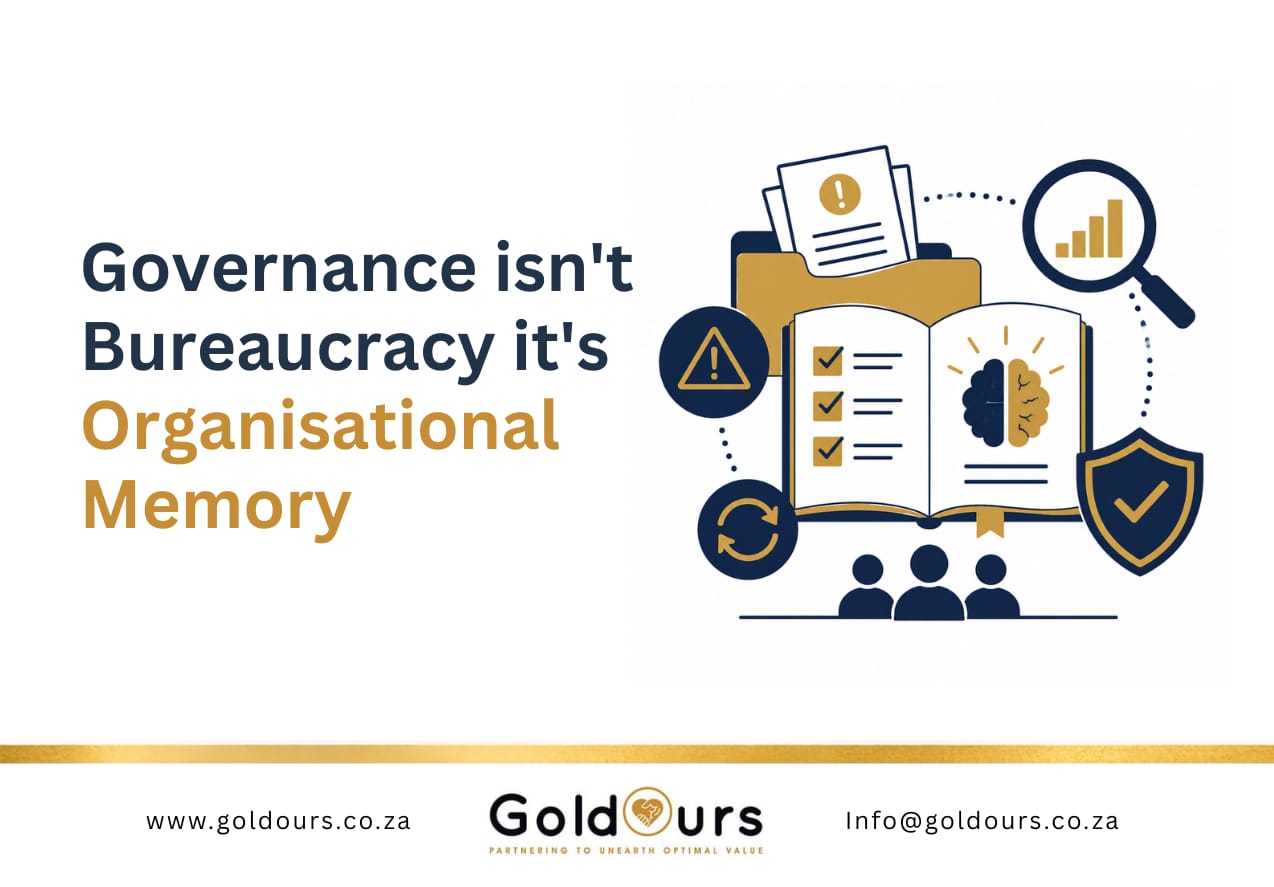
Governance isn't bureaucracy — it's organisational memory
Organisations don't usually repeat mistakes because people forget. They repeat them because systems fail to remember.
Every organisation accumulates experience. Projects succeed. Projects fail. Audits identify weaknesses. Customers provide feedback. Employees develop practical solutions. Incidents reveal vulnerabilities.
Yet surprisingly few organisations consistently convert these experiences into lasting organisational knowledge.
Instead, lessons often remain with individuals. When those individuals leave, the organisation starts learning the same lessons all over again.
Experience without learning has little value
Many post-project reviews produce excellent recommendations. Internal audits identify recurring issues. Risk assessments highlight similar concerns year after year. Yet, the same operational failures persist.
Why? Because organisations document lessons without embedding them into governance processes. Knowledge becomes archived instead of applied.
Governance protects institutional memory
Strong governance creates systems that preserve learning. Policies evolve after experience. Controls improve after incidents. Decision-making frameworks adapt. Training reflects real organisational challenges. Assurance activities verify whether improvements have actually been implemented.
In this way, governance becomes the organisation's collective memory. It ensures valuable experience remains available long after individuals move on.
Continuous improvement requires discipline
Learning does not happen automatically. It requires deliberate governance practices. Regular reviews.
Structured after-action evaluations. Independent assurance. Performance monitoring. Knowledge sharing across business units.
Continuous improvement becomes a part of normal operations rather than an occasional initiative.
Sustainable organisations learn faster
Competitive advantage increasingly depends on how quickly organisations learn. Those that continuously improve become more efficient. They manage risk more effectively. They strengthen stakeholder confidence. They avoid repeating costly mistakes.
Most importantly, they build cultures where learning is viewed as a strategic capability rather than a compliance obligation.
The GoldOurs Perspective
At GoldOurs, we see governance as far more than policies and procedures. It is the framework that captures experience, strengthens organisational learning and ensures improvement becomes part of everyday operations.
Because organisations that remember well adapt better. And organisations that adapt better remain stronger for longer.