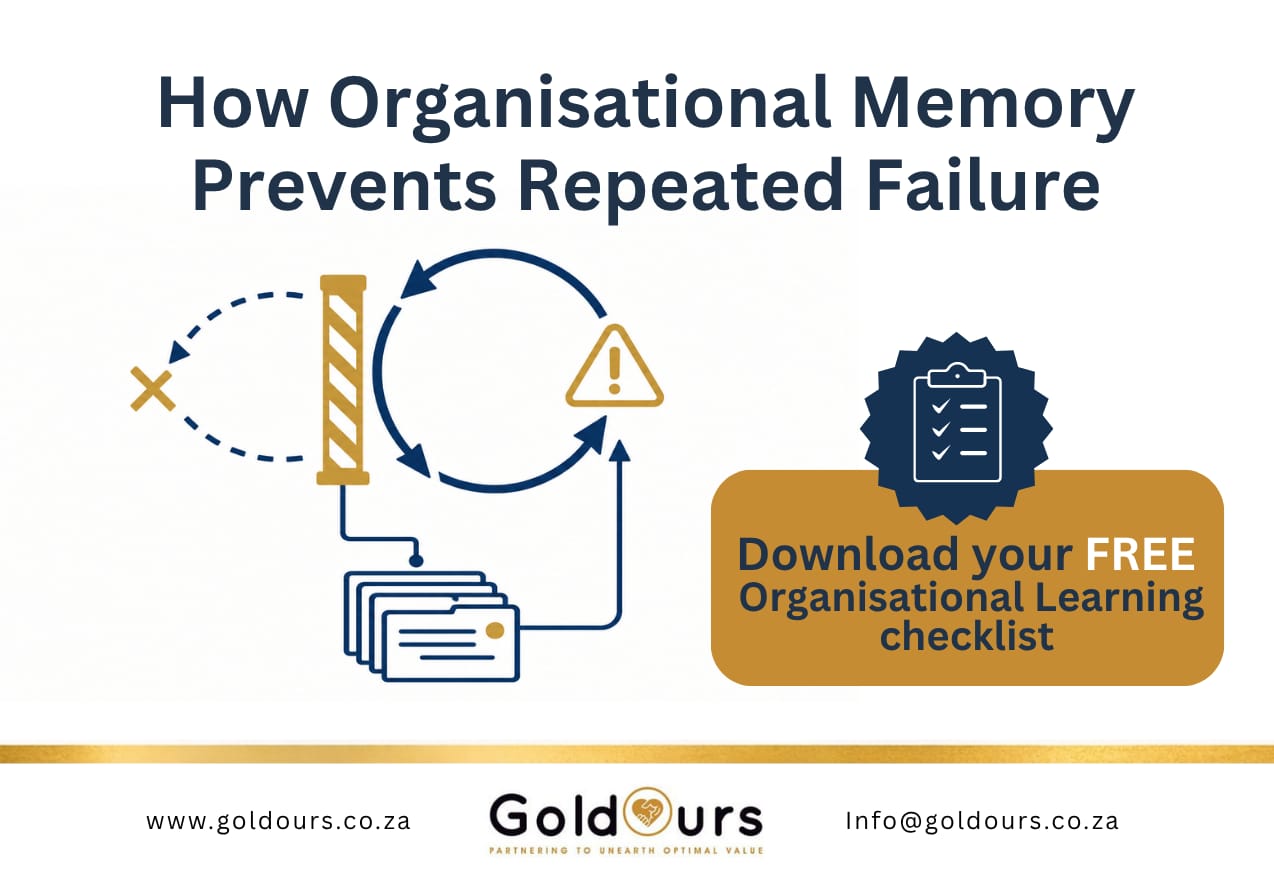

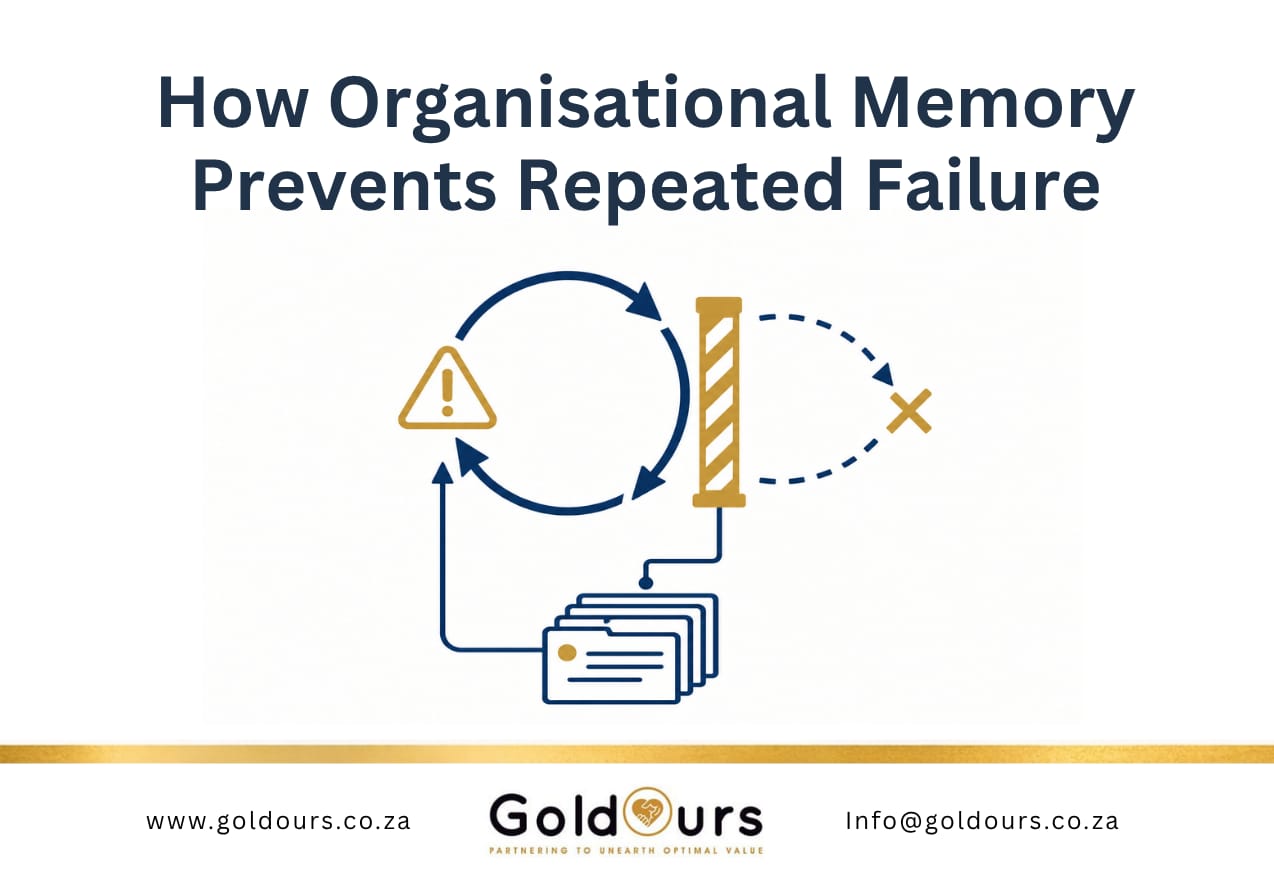
Organisational Memory Prevents Repeated Failure
Some organisations solve the same problem more than once. A project overruns. A process breaks down. A complaint escalates. A key employee leaves and takes critical knowledge with them.
The organisation responds. A meeting is held. A corrective action is agreed. A new procedure may even be introduced. For a while, the problem disappears.
Then, months later, something remarkably similar happens again. Repeated failure is not always caused by a lack of effort or competence. Sometimes the organisation has simply failed to remember what it already learned.
Experience only becomes valuable when it is retained
Organisations accumulate knowledge constantly. They learn through projects, mistakes, audits, customer complaints, operational failures, staff turnover and periods of rapid change.
But experience alone does not create organisational memory.
That happens only when important learning is captured, shared and reflected in the way the organisation works. Without this, valuable knowledge remains with individuals. A manager knows why a particular process was changed. An employee remembers the problem that occurred five years ago. A project team understands why a certain approach failed. Then people move roles, leave the organisation or simply stop being involved. The knowledge disappears with them.
The organisation may still retain the policy or procedure, but lose the reasoning behind it. That is how old mistakes can quietly return.
When lessons stay in the meeting
After a significant failure, organisations often spend considerable time discussing what happened.
There may be a review. Lessons are identified. Recommendations are recorded. Responsibilities are allocated. The weakness often appears later.
- Were those lessons incorporated into the organisation's processes?
- Did they change the way decisions are made?
- Were they communicated to people who were not involved in the original incident?
- Would a new employee joining six months later understand what had been learned?
- If not, the organisation may have documented the lesson without actually retaining it.
Minutes and reports have value. But organisational memory needs to influence future behaviour.
Repeated problems are useful information
When the same type of failure keeps returning, leadership teams should resist treating each occurrence as a separate incident. The repetition itself matters.
A recurring procurement problem may reveal weak controls. Repeated project delays may point to unrealistic planning assumptions. The same customer complaint appearing across different teams may indicate a process weakness rather than poor individual performance. A risk that continually returns to the register after being marked as addressed may suggest that the underlying cause has never been resolved.
The important question is therefore not only: What went wrong this time?
It is also: Have we seen this before — and if so, why did the organisation fail to retain what it learned?
Staff turnover exposes weak organisational memory
One of the clearest tests of organisational memory occurs when experienced people leave.
In many organisations, important knowledge sits in conversations, personal files, email histories and individual experience. The formal job description rarely captures all of it.
When the person leaves, others may discover that critical relationships, workarounds, historical decisions or process knowledge were never properly transferred.
This creates vulnerability.
The new employee may have the technical ability to perform the role, but still lack years of accumulated organisational context. The greater the organisation's reliance on individual memory, the greater the operational risk created by staff movement.
Succession, therefore, involves more than replacing a person. It also requires retaining what the organisation knows.
Policies cannot carry memory on their own
Policies, manuals and procedures are important. But they are not enough.
A procedure may tell employees what to do without explaining why it matters. That distinction becomes particularly important when circumstances change. People who understand the reasoning behind a control or process can exercise judgment. People who only know the rule may abandon it when the rule becomes inconvenient or appears outdated.
Strong organisational memory, therefore, includes context.
- Why was this process introduced?
- What problem was it designed to prevent?
- What happened previously?
- Which risks are being controlled?
- This context makes institutional knowledge more durable.
Learning should change the system
One of the most useful questions leadership teams can ask after a significant issue is: What will be different next time because this happened?
If the answer is only that individuals have been reminded to be more careful, the organisation may not have learned very much.
Meaningful learning can result in a changed process, clearer accountability, different decision rights, improved controls, better information or a stronger handover. The lesson becomes part of the system. That matters because people change.
A good organisational system should not depend on everyone remembering every past incident personally.
Boards should look for evidence of learning
Organisational memory is also a governance issue.
Boards and committees frequently receive reports on incidents, audit findings, project failures and corrective actions. But closing an action does not necessarily mean that the organisation has learned from it.
Boards can ask:
-
- Has this type of problem occurred before?
-
- What did we learn from the previous occurrence?
-
- What changed as a result?
-
- How do we know that the change is working?
-
- Could the same problem return when particular individuals leave?
- Has the lesson been incorporated into normal organisational practice?
These questions shift the discussion from whether an issue has been closed to whether the organisation has strengthened itself because of the experience.
Five questions to test organisational memory
Leadership teams can start with five practical questions:
-
- Which problems have appeared more than once?
-
- Where does important knowledge still depend on individual employees?
-
- What lessons from past failures have actually changed the way we work?
-
- How do we transfer critical knowledge when people change roles or leave?
-
- How do we know that corrective actions have produced lasting improvement?
The answers can reveal where organisational knowledge is being retained — and where it may be disappearing.
The GoldOurs Perspective
Organisations do not become resilient simply because they have experienced difficulty. They become more resilient when they retain what the difficulty taught them.
Strong organisational memory connects experience to action. It captures important learning, transfers knowledge, strengthens systems and reduces the likelihood that the organisation will repeatedly pay for the same lesson.
GoldOurs works with boards and executive teams to strengthen governance, organisational resilience, accountability and the systems that support effective performance.
Use the GoldOurs Organisational-Learning Checklist to assess whether important lessons are becoming part of the way your organisation works.