
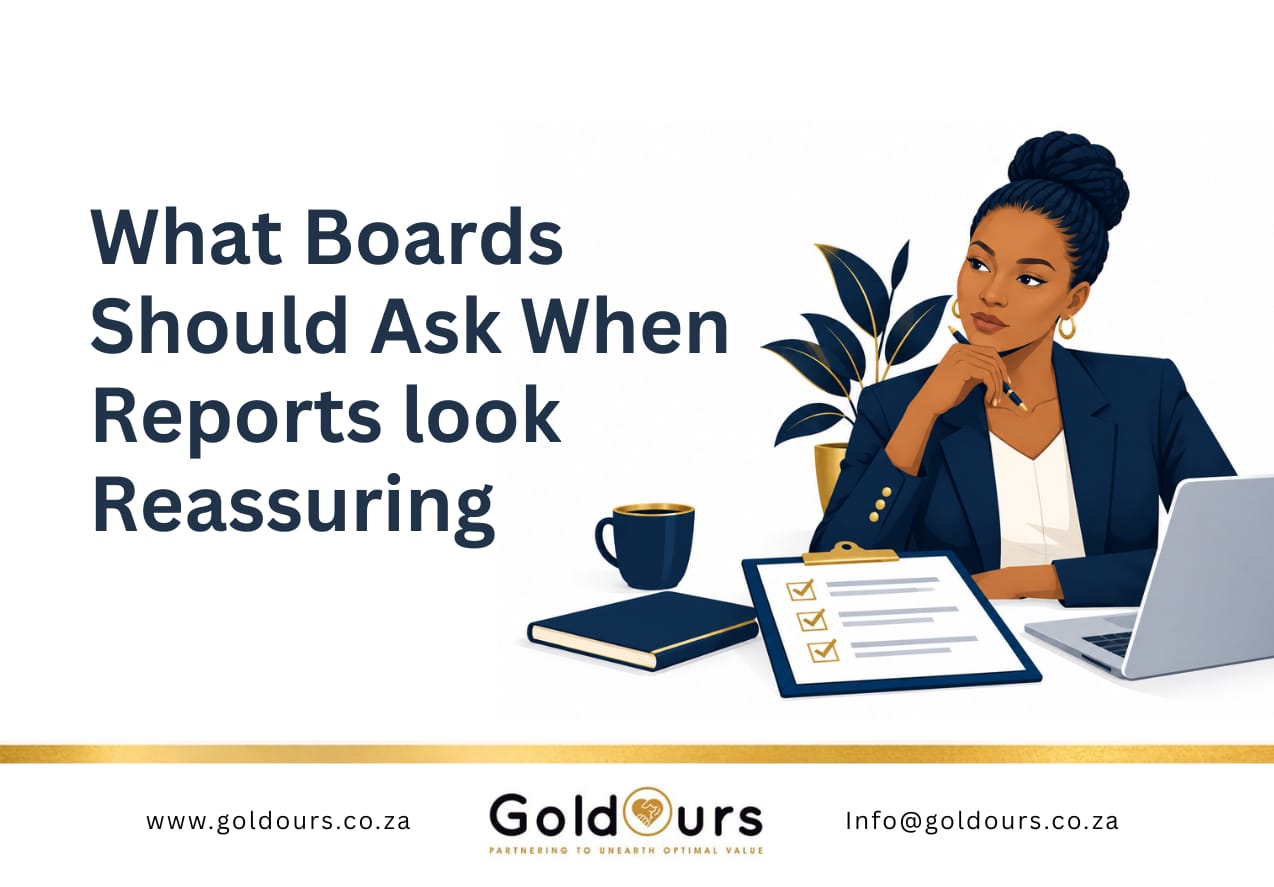
What Boards Should Ask When Reports Look Reassuring
A board pack can be comprehensive, professionally presented and full of reassuring indicators — and still fail to tell the board what it most needs to know.
The numbers may be on target. Risks may be described as “under control”. Projects may appear to be progressing. Compliance reports may show few exceptions.
Yet elsewhere in the organisation, decisions are slowing down, the same problems keep resurfacing, employees are working around broken processes and executives are spending increasing amounts of time resolving issues that should never have reached them.
The problem is not necessarily that the information presented to the board is wrong. It may simply be incomplete.
Good reporting does not automatically mean good visibility
Boards depend on management information to fulfil their oversight responsibilities. But reporting systems often develop around what is easiest to measure rather than what is most important to understand.
Financial performance is measured. Compliance is recorded. Projects are assigned red, amber or green status. Risk registers are updated.
What may be less visible is the friction underneath those reports.
A project classified as “green”, for example, may still depend heavily on one senior executive personally resolving problems. A business unit may meet its targets while losing key people. A compliance indicator may remain satisfactory even though employees have found informal ways around an impractical process.
The report is technically correct. But the board may still be seeing only part of the picture. This is why boards need to look beyond the information presented and ask what the information might not be showing.
Ask what changed — not only what happened
Many board reports are designed to describe performance during a reporting period.
Boards also need to understand movement.
- What is becoming more difficult?
- Where are problems recurring despite previous interventions?
- Which risks have remained on the register for several reporting periods without meaningful reduction?
- Where are targets being achieved only because leaders or employees are compensating for weak systems?
Trend information is often more revealing than a single performance number. A board may be less concerned that a target was missed once than that the same operational problem has appeared in four consecutive quarters.
Similarly, repeated management intervention may tell the board more about organisational health than a favourable headline indicator.
Ask what sits behind the green status
Traffic-light reporting can be useful, but it can also encourage false comfort.
The most useful question is often:
What would have to go wrong for this indicator to move from green to amber or red?
That question changes the conversation.
It shifts the focus from reporting what has already happened to understanding fragility.
A healthy organisation should be able to explain not only whether performance is currently satisfactory, but how resilient that performance is.
Boards should therefore ask:
-
Which targets depend on a small number of individuals?
-
Which areas have little room for error?
-
Where are temporary workarounds keeping performance on track?
-
Which assumptions must remain true for the current forecast to hold?
-
What information would management want the board to know if the formal report did not exist?
These questions help reveal whether good results are sustainable or simply being maintained through extraordinary effort.
Ask where the organisation is learning
Recurring problems are particularly important. If the same governance, operational or people issues repeatedly return to board or committee agendas, the question should not only be whether the latest incident has been resolved.
The deeper question is: Why has the organisation not learned enough to prevent the problem from returning?
Boards should look for evidence that corrective action changes the underlying system.
- Has accountability become clearer?
- Has a process been redesigned?
- Have decision rights changed?
- Has the organisation captured what it learned?
- Or has another temporary intervention simply allowed the problem to disappear from the next report?
Resolving incidents matters. Building organisational capability matters more.
Ask what management is worried about
One of the simplest board questions can also be one of the most revealing: What concerns you that is not adequately reflected in this report?
That question creates space for judgment.
Not every emerging risk can immediately be expressed as a KPI. Leaders may notice patterns before the data confirms them: increasing employee frustration, deteriorating relationships between functions, customer concerns, dependence on key individuals or decisions that are taking longer than they should.
Boards need quantitative information, but they also need informed management judgement. The strongest reporting systems allow both.
A useful test
Before accepting a reassuring report, boards can ask five questions:
-
- What is getting worse even though the headline numbers still look good?
-
- Which problems have appeared more than once?
-
- Where does current performance depend on exceptional individual effort?
-
- What are the assumptions behind the positive outlook?
-
What would management tell us if it were not constrained by the reporting template?
These questions do not undermine management. They improve the quality of oversight.
The GoldOurs Perspective
Effective board reporting should do more than confirm that the organisation has met its targets. It should help the board understand performance, resilience, emerging risk and the organisation’s ability to learn.
Boards, therefore, need reports that support conversation rather than simply record information. A reassuring report should not end the discussion. It should create better questions.
GoldOurs works with boards and executive teams to strengthen governance, reporting, accountability and the systems that support effective decision-making.
Use the Board Reporting Checklist alongside this article to test whether your board reports are helping directors see what matters — including what may be hidden behind reassuring headline indicators.