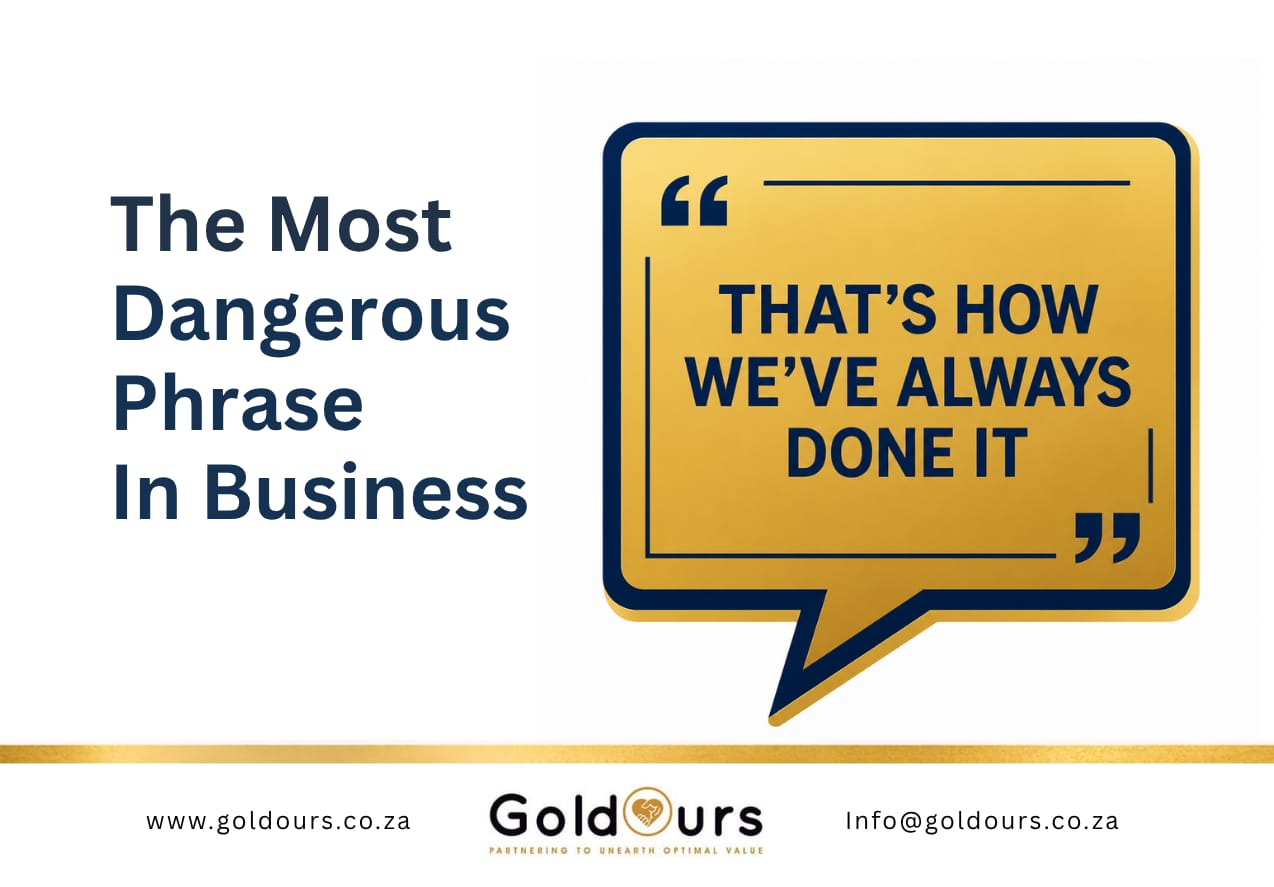
The Most Dangerous Phrase in Business: “That’s How We’ve Always Done It”
Every organisation has ways of doing things that have worked for years. Processes become established. Decisions follow familiar patterns. People know what is expected of them. That consistency can be valuable.
Until it becomes resistance to change.
“That’s how we’ve always done it” can sound harmless. But when it becomes the reason not to question, adapt or improve, it signals something more serious.
The organisation may have stopped asking whether the way it works is still the best way to move forward. And that is where stagnation begins.
When experience becomes a constraint
Successful organisations naturally build routines. They learn what works, develop systems around it and repeat those behaviours. The danger comes when past success becomes the justification for future decisions.
Markets change. Customers change. Technology changes. Employees change.
A process that made perfect sense five years ago may no longer serve the organisation today. Yet challenging established ways of working can be difficult, particularly when they are closely associated with previous success.
The question shifts from: “Is this still the best way?” to “Why should we change something that has always worked?” That is a very different conversation.
Culture determines whether people challenge the status quo
Innovation does not always begin with a new technology or a breakthrough idea. Sometimes it begins with permission to question.
Employees often see opportunities for improvement long before leadership does. They experience inefficient processes, unnecessary approvals and changing customer expectations every day.
But they will only raise these issues if the culture allows them to. When suggestions are repeatedly dismissed, people learn quickly. They stop challenging. They stop suggesting. Eventually, they simply work around the problem.
Leadership may interpret the silence as agreement. In reality, it may be disengagement.
An organisation that wants to innovate therefore needs more than an innovation strategy. It needs a culture in which constructive challenge is welcomed rather than resisted.
Leadership sets the boundaries for change
Agility does not mean constantly changing direction. Nor does innovation mean abandoning everything that has worked in the past. It means being able to distinguish between practices that continue to create value and those that exist largely because nobody has challenged them.
That requires curiosity from leadership. Instead of asking “Why do we need to change this?”
leaders can ask “Would we design it this way if we were starting today?”
That single question can reveal processes, behaviours and assumptions that have outlived their usefulness.
Leaders can also ask teams where unnecessary friction exists, which decisions take too long and what they would change if they had the authority to do so. But asking is only the beginning.
Nothing discourages innovation faster than repeatedly inviting employees to contribute ideas and then doing nothing with them.
People need to see that constructive challenge can lead to meaningful action.
Creating an organisation that can adapt
Adaptable organisations are not those that constantly reinvent themselves. They are organisations capable of questioning themselves. They retain what works. They challenge what no longer does.
And they create enough trust for people to say when something could be better.
This requires both openness and accountability. Ideas should be challenged. Evidence should be considered. Decisions should be made. And when change is necessary, leaders need to support it consistently.
Final thought
Tradition is not necessarily the enemy of progress. Unquestioned tradition can be. The organisations most capable of sustaining growth are not those that abandon everything that made them successful.
They are those willing to examine what made them successful and ask whether it will still make them successful tomorrow.
Because sometimes the most important question a leader can ask is simply “Why are we still doing it this way?”
At GoldOurs, we help organisations strengthen leadership capability and create cultures where agility, accountability and innovation support sustainable performance.
Because what got an organisation here should never automatically determine where it goes next.