


Connecting CSI to business
Some will find it hard to believe that corporate social investment (CSI) has been around for more than 200 years, beginning with the initiatives of industrialists Andrew Carnegie and John D Rockefeller.
Since then, CSI has evolved, but not far from its intention to do good, not only for others but for the businesses that are advancing development investments that address the historical inequalities in South Africa, in particular.
South Africa’s CSI roots date to the 1950s, when Anglo American established its Chairman’s Fund to pioneer large-scale social investment.
It was only in the 1990s that organisations, both globally and in South Africa, became more strategic about CSI. Fortuitously, it was at the same time that the King Report on Corporate Governance, and environmental, social and governance requirements took centre stage.
It’s clear that CSI makes more sense when it connects to business strategy, transforming it from a "nice-to-have" charitable expense into a strategic imperative that drives long-term profitability, enhances brand reputation, and strengthens stakeholder relationships.
By aligning social initiatives with core business competencies—such as leveraging technology for community education or leveraging supply chains to empower local entrepreneurs—companies create shared value that benefits society and the bottom line.
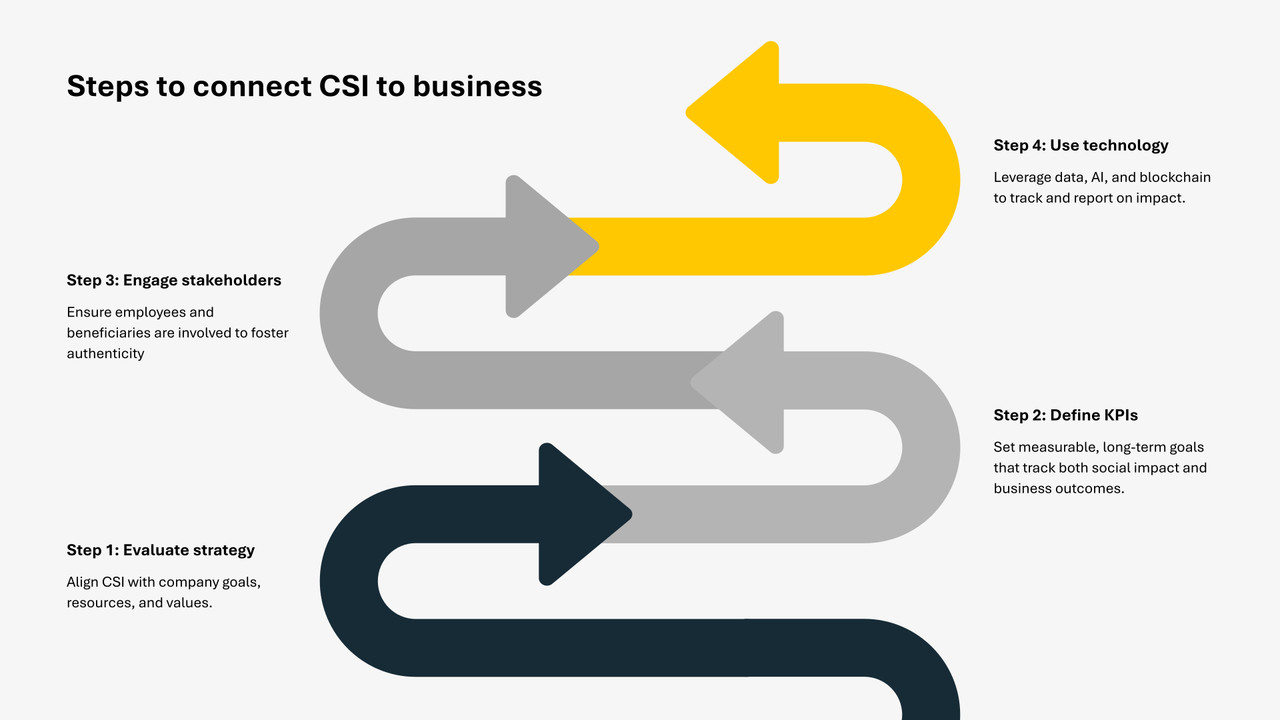
But is it easier said than done? Here are four steps to take to connect CSI to your business:
So why is it important:
· Strategic alignment (creating shared value)
Align CSI with the core business to ensure sustainability and relevance. It needs to make sense why your business is getting involved. For example, support small businesses in the company's supply chain to become more compliant and efficient, thereby strengthening the company's own supply chain.
· Boosting brand reputation and trust
CSI builds loyalty, trust, and transparency among consumers, employees, and investors.
· Improving employee engagement and talent acquisition
A robust, purpose-driven CSI strategy increases employee pride, morale, and productivity. This is a major contributor to attracting talent and retaining staff.
· Enhancing risk management and operations
CSI can be used to build a "social license to operate," particularly in regions with high inequality or in industries that directly impact communities. Communities help to mitigate the long-term risks, while regulatory compliance ensures these expenditures are both compliant and effective.
· Innovation and growth opportunities
Connecting CSI to business can uncover new market opportunities when undeveloped communities open up to products and services. Furthermore, sustainable solutions can lead to new, eco-friendly or socially responsible products that meet growing consumer demand.