
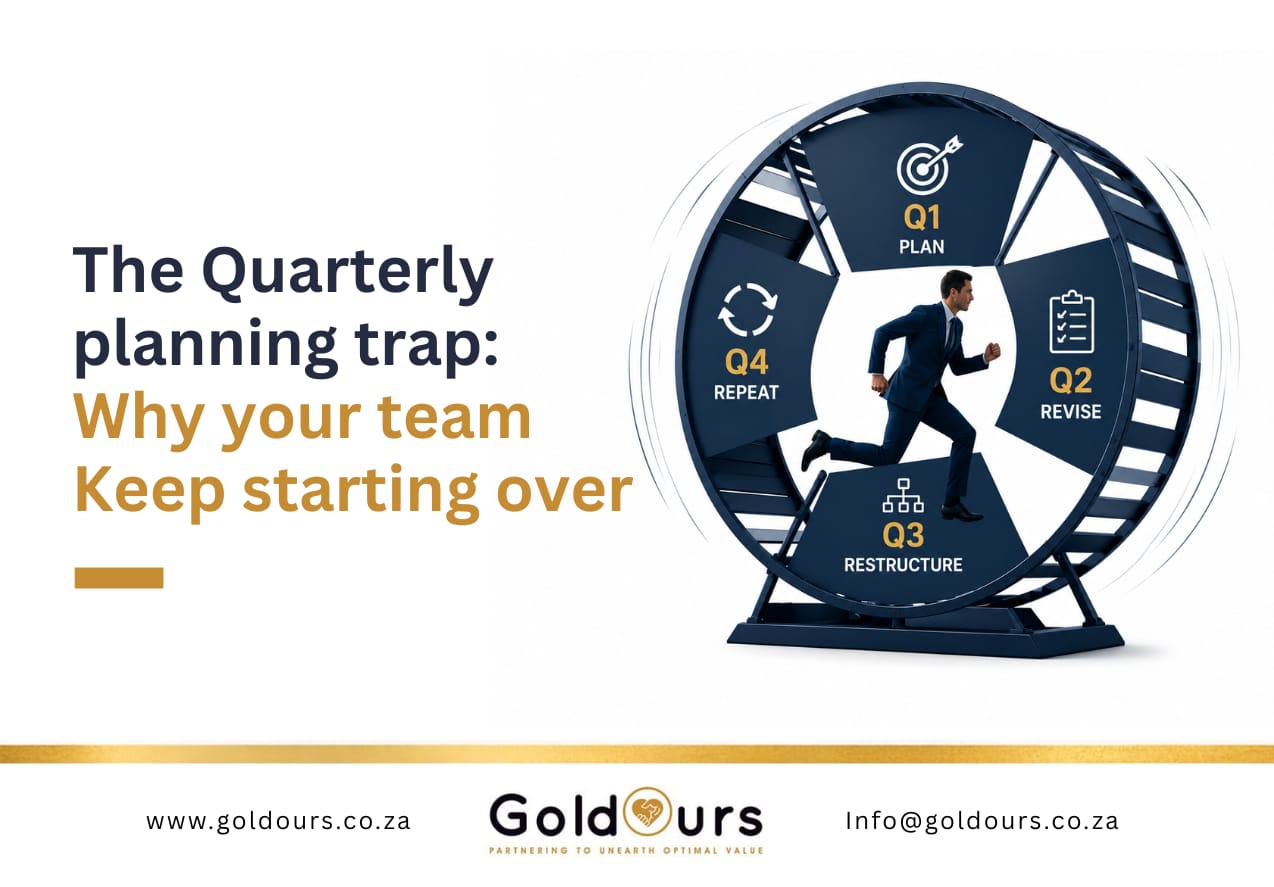
The Quarterly planning trap: Why your team keeps starting over
Many organisations spend more time planning than progressing.
Every quarter begins with renewed energy.
New priorities are identified.
Targets are revised.
Projects are restructured.
Teams are encouraged to focus on what matters most.
Yet three months later, the cycle repeats.
The organisation feels as though it is constantly moving.
But rarely moving forward.
This is the quarterly planning trap.
And it quietly undermines execution in organisations of every size.
The illusion of progress
Most leadership teams believe regular planning creates agility. To some extent, it does.
Markets change. Risks emerge. Opportunities evolve. Organisations need the ability to adapt. The problem occurs when planning becomes a substitute for execution.
Instead of building momentum around long-term priorities, organisations continually reset their focus.
Each quarter introduces new initiatives, revised objectives, and shifting expectations.
The result is not agility. It is a disruption.
Warning signs
A lack of strategic continuity often reveals itself through:
- - Priorities changing every few months
- - Projects being abandoned before completion
- - Teams struggling to maintain momentum
- - Employees feeling uncertain about long-term goals
- - Leadership repeatedly revisiting decisions that were already made.
From the outside, the organisation appears responsive. Inside, execution is fragmented.
Why growth makes this worse
As organisations become larger, consistency becomes increasingly important. More teams are involved. More resources are committed. More stakeholders depend on successful execution.
Frequent shifts in direction create confusion throughout the organisation.
Employees become cautious.
Managers delay decisions.
Teams hesitate to invest fully in initiatives that may soon be replaced.
What begins as responsiveness eventually becomes instability.
The real cost of constantly starting over
Organisations often underestimate the consequences of reactive management.
The hidden costs include:
Lost momentum
Projects repeatedly restart before benefits can be realised.
Employee disengagement
People become frustrated when priorities constantly change.
Reduced accountability
Success becomes difficult to measure when objectives keep shifting.
Strategic fatigue
Teams lose confidence in long-term initiatives because they expect another change in direction.
Over time, execution weakens even though planning activity increases.
Agility is not constant change
One of the biggest misconceptions in leadership is that adaptability requires frequent strategic shifts.
It doesn't.
High-performing organisations adapt within a stable strategic framework. Their long-term priorities remain clear. Their operating rhythm remains consistent. Their governance structures ensure that adjustments support the strategy rather than replace it. True agility is disciplined. Not reactive.
What leaders should do differently
1. Establish long-term strategic priorities
Not every challenge requires a new initiative.
Long-term priorities create organisational stability.
2. Create a strategic operating rhythm
Quarterly reviews should assess progress, remove barriers, and refine execution.
They should not automatically reset direction.
3. Align governance with continuity
Governance provides the discipline to distinguish between necessary adaptation and unnecessary disruption.
It helps organisations stay focused while remaining responsive.
Final thought
When organisations struggle to execute, they often assume the answer lies in better planning.
But sometimes the problem is not the plan's quality. It is the constant replacement of one plan with another. Because growth rarely comes from repeatedly starting over. It comes from sustaining focus long enough to achieve meaningful results.
GoldOurs helps leaders turn compliance, talent, and strategy into a single, powerful engine for tangible results.