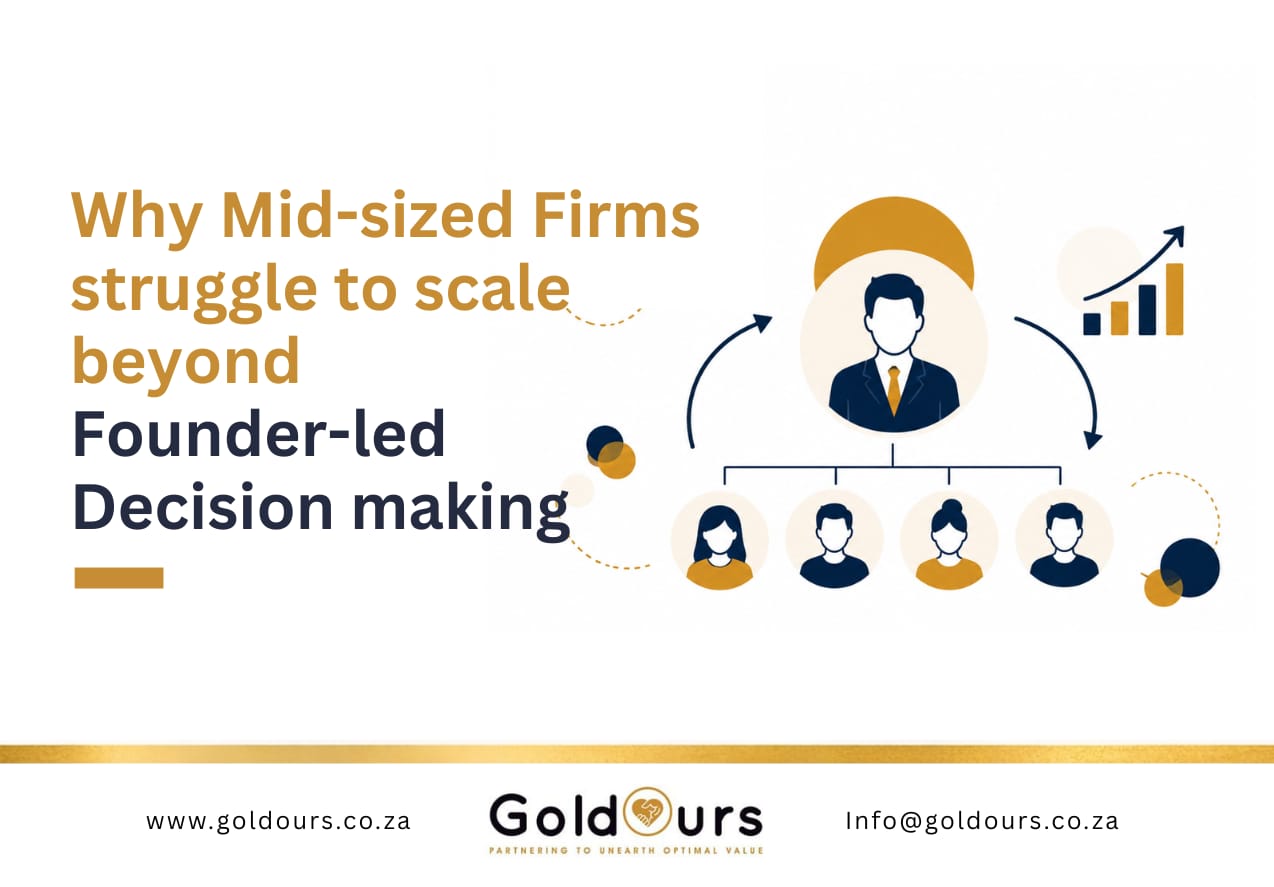
Why Mid-Sized Firms struggle to scale beyond Founder-Led Decision-Making
Most founders become the very thing that limits their company's growth. Not intentionally. In fact, the behaviours that helped build the business are often the same behaviours that ultimately hold it back.
The founder knows the customers.
The founder understands the operations.
The founder makes the critical decisions.
The founder solves the problems.
For years, this has worked exceptionally well.
Until it doesn't.
As the business grows, every important decision continues to flow through one person. Teams wait for approval. Managers hesitate to act. Opportunities slow down.
Growth begins to encounter a bottleneck.
And that bottleneck often sits at the top of the organisation.
The founder-led success trap
Founder-led businesses are often built on speed.
Decisions are made quickly.
Communication is direct.
Problems are resolved immediately.
In the early stages, centralised decision-making can be a competitive advantage.
But growth changes the equation.
As the organisation grows larger and more complex, the founder's capacity does not keep pace with the business.
The organisation requires more decisions, more leadership, and more accountability than any single individual can provide.
Yet many businesses continue to operate as though they are still start-ups.
This is where scale begins to stall.
Warning signs
Founder dependency rarely announces itself openly.
It usually appears through everyday frustrations:
- - Managers constantly seek approval before acting
- - Decisions are delayed while waiting for executive input
- - Teams avoid taking ownership
- - Opportunities are missed because responses are too slow
- - The founder feels overwhelmed and stretched across multiple priorities.
From the outside, the business appears successful.
Inside, growth is becoming increasingly dependent on one person's availability.
Why growth makes this worse
As organisations grow, decision-making naturally becomes more distributed.
New teams emerge.
New markets develop.
New operational challenges arise.
The business needs leaders at every level who can make sound decisions aligned with strategic objectives.
When authority remains concentrated at the top, the organisation struggles to keep pace with its own growth.
Instead of building leadership capacity, it builds dependency.
And dependency does not scale.
The real cost of centralised leadership
Most organisations underestimate how expensive founder dependency becomes over time.
The hidden costs include:
Slower execution
Decisions become trapped in approval processes.
Leadership fatigue
Founders become overwhelmed by issues that should be resolved elsewhere.
Reduced innovation
Employees stop bringing forward ideas when they believe decisions are predetermined.
Succession risk
The business becomes vulnerable because critical knowledge and authority remain concentrated in one individual.
Eventually, growth becomes constrained by leadership capacity rather than market opportunity.
Delegation is not a loss of control
One of the biggest misconceptions among growing businesses is that delegation reduces control.
In reality, the opposite is true.
Without clear delegation, leaders become consumed by operational decisions and lose visibility of strategic priorities.
True leadership is not about making every decision.
It is about creating the conditions for good decisions to be made throughout the organisation.
That requires trust.
But it also requires structure.
What should leaders do differently?
1. Clarify decision rights
People should understand what they can decide, what requires consultation, and what requires approval.
Clarity builds confidence.
2. Develop leadership capability
Growth depends on creating leaders, not followers.
Managers need the authority and skills to make decisions within their areas of responsibility.
3. Build governance around accountability
Delegation without accountability creates risk.
Governance ensures decisions remain aligned to organisational objectives while empowering leaders to act.
Final thought
Many businesses believe growth depends on finding new customers, new markets, or new opportunities.
Sometimes growth depends on something much simpler.
The willingness of leaders to let others lead.
Because organisations do not scale when decision-making remains concentrated at the top.
They scale when leadership capability is distributed throughout the business.
GoldOurs helps leaders turn compliance, talent, and strategy into a single, powerful engine for tangible results.