The cost of leadership misalignment nobody measures
Most organisations don’t suffer from a lack of leadership. They suffer from leaders pulling in different directions. The executive team agrees on the strategy. The priorities are documented. The objectives are communicated.
Yet, in practice, employees receive very different messages.
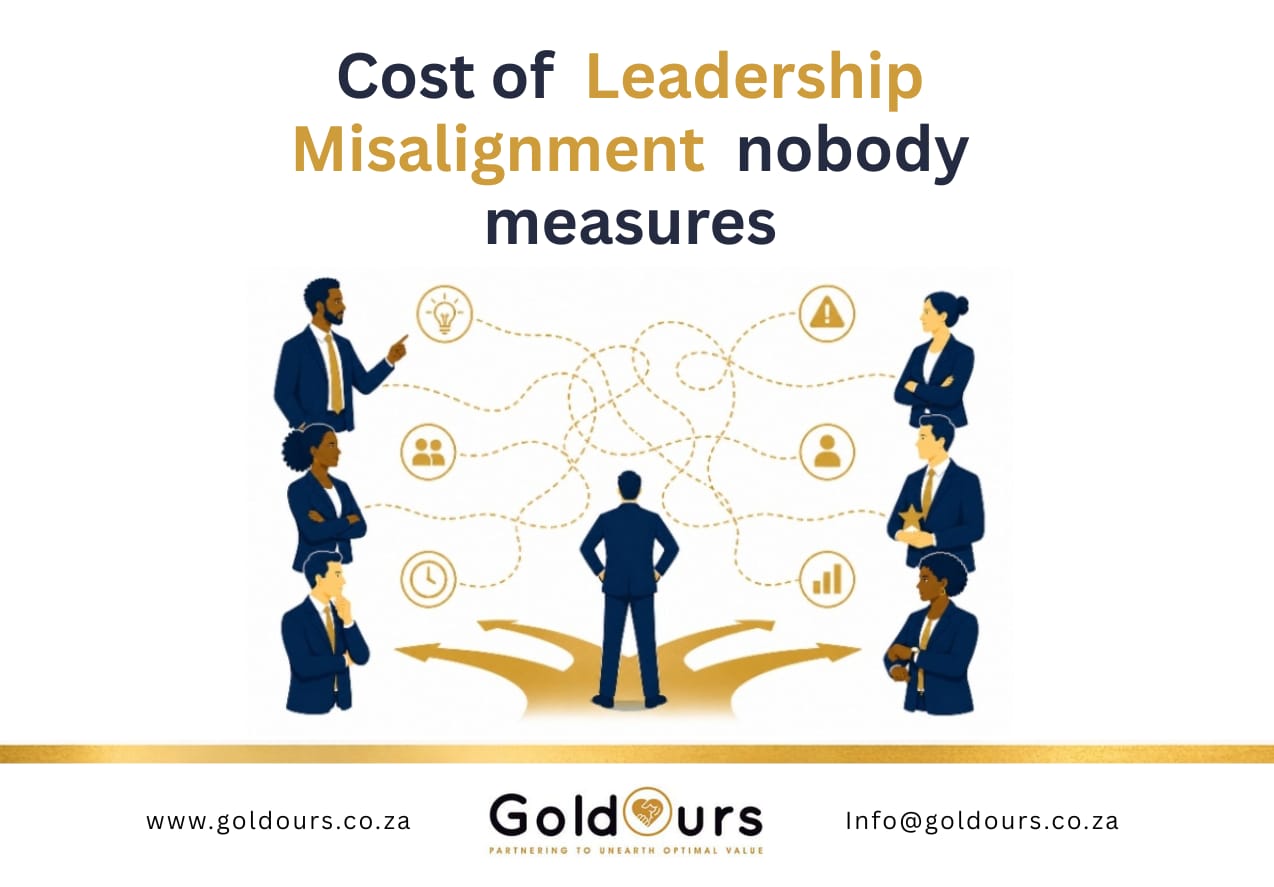
One leader prioritises innovation. Another demands caution. One encourages collaboration. Another rewards individual performance. One promotes long-term thinking. Another focuses on immediate results.
Everyone is trying to lead. But not necessarily in the same direction.
This is where cultural fragmentation begins.
And it may be one of the most expensive organisational challenges that leaders rarely measure.
The alignment illusion
Many leadership teams assume they are aligned because they agree in meetings. But organisational alignment is not determined by what leaders say. It is determined by what leaders consistently do.
Employees pay close attention to behaviour.
They observe:
· - What gets rewarded.
· - What gets challenged.
· - What leaders prioritise.
· - How decisions are made.
When leadership behaviours differ significantly, employees receive conflicting signals about what success actually looks like.
Over time, the organisation develops multiple cultures instead of one.
This is where strategic cohesion begins to weaken.
Warning signs
Leadership misalignment often appears quietly:
· - Teams interpret priorities differently.
· - Departments operate independently.
· - Decision-making becomes inconsistent.
· - Internal conflict increases.
· - Employees receive mixed messages from leaders.
From the outside, the organisation still appears stable. Inside, however, confusion is growing.
Why does growth make this worse
As organisations grow, leadership influence becomes more distributed. More managers make decisions. More teams shape culture. More employees rely on leadership cues to understand what matters.
When executive behaviours are inconsistent, the organisation struggles to create a shared identity. Silos emerge. Priorities diverge. Trust declines.
The business becomes increasingly difficult to coordinate.
What started as a leadership issue eventually becomes an organisational performance issue.
The real cost of leadership misalignment
Most organisations never quantify the cost of executive inconsistency. But the consequences are significant.
Slower execution
Teams spend more time reconciling competing priorities.
Reduced accountability
Employees become uncertain about expectations.
Cultural fragmentation
Different parts of the organisation develop different values and behaviours.
Leadership fatigue
Executives spend increasing amounts of time resolving internal friction.
Over time, momentum slows as the organisation no longer moves in a single direction.
Alignment is a behavioural discipline
One of the biggest misconceptions in leadership is that alignment is achieved through communication.
It isn’t. Alignment is created through consistency.
The most effective leadership teams:
· - Reinforce the same priorities.
· - Make decisions using the same principles.
· - Model the behaviours they expect from others.
· - Hold one another accountable.
Because organisations eventually mirror what leaders repeatedly reinforce.
What should leaders do differently?
1. Define the behaviours that support the strategy
Culture should not be left to interpretation.
Leaders must agree on the behaviours that drive success.
2. Create leadership accountability
Alignment should be measured and reinforced just like performance.
3. Build governance around leadership cohesion
Governance creates the discipline needed to sustain consistency and reduce organisational friction.
Final thought
When organisations struggle to execute, they often focus on systems, structures, and processes. But sometimes the real issue is much simpler. The leadership team is unintentionally sending different messages about what matters.
Because strategy succeeds when leaders move together. And culture becomes fragmented when they don’t.
GoldOurs helps leaders turn compliance, talent, and strategy into a single, powerful engine for tangible results.