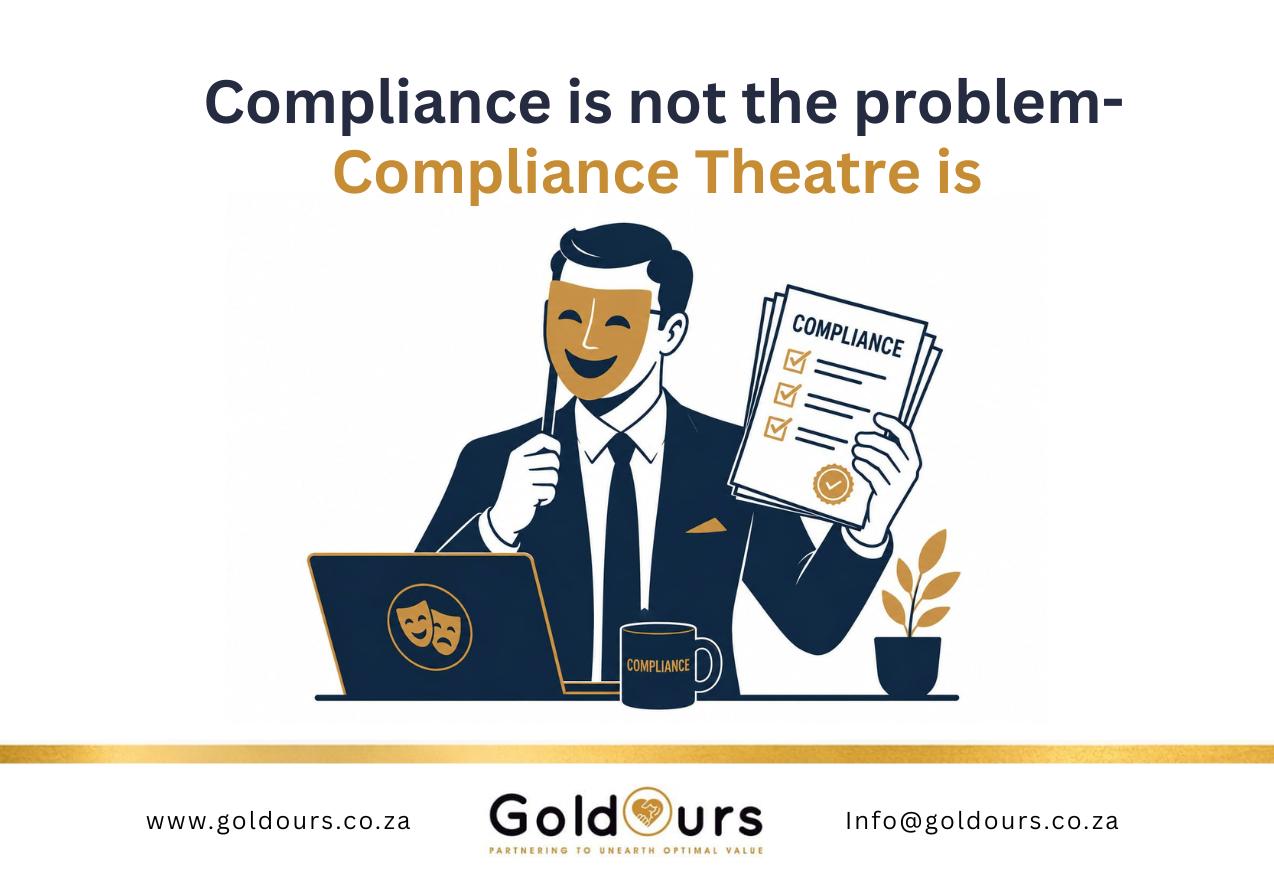
Compliance is not the problem — Compliance theatre is
Most organisations don't have a compliance problem. They have a governance problem disguised as compliance. Policies exist. Registers are updated. Committees meet. Audit files are immaculate.
Yet the organisation still experiences recurring risks, inconsistent decisions, poor accountability and strategic drift.
This is compliance theatre—the appearance of governance without the operational discipline that governance is intended to create.
When compliance becomes performance
Many organisations unintentionally treat compliance as an event rather than a management capability.
Energy increases before:
- - External audits
- - Regulatory inspections
- - Board meetings
- - Annual reporting cycles
- Documentation is refreshed.
- Evidence is collected.
- Controls are demonstrated.
Then everyone returns to business as usual. The result is governance that exists primarily for external consumption rather than internal performance.
True governance should be largely invisible because it is embedded in how decisions are made every day.
The cost of tick-box governance
Compliance theatre creates a dangerous illusion. Leadership assumes that because the organisation is compliant, it is also well governed.
The two are not the same.
An organisation can meet every regulatory requirement while still suffering from:
- - Slow decision-making
- - Weak accountability
- - Operational inconsistency
- - Repeated operational failures
- - Poor strategic execution
- - Hidden organisational risks
Compliance measures whether required activities occurred. Governance measures whether the organisation consistently makes better decisions. Those are very different outcomes.
Governance should create business value
High-performing organisations do not view governance as an administrative burden. They use it to improve organisational performance.
Effective governance provides:
- - Greater strategic clarity
- - Faster, more confident decision-making
- - Better visibility of operational risks
- - Consistent leadership behaviours
- - Stronger organisational trust
- - Improved execution across teams
Instead of slowing the business down, governance removes uncertainty. It becomes an enabler rather than an obstacle.
Asking better questions
Rather than asking: "Are we compliant?"
Executive teams should also ask:
- - Are our governance processes improving decisions?
- - Do leaders understand why controls exist?
- - Are risks identified before they become incidents?
- - Does governance help us execute strategy faster?
- - Would our governance still function if there were no audit?
These questions shift governance from administration to organisational capability.
Governance is a strategic asset
Organisations that outperform their competitors rarely do so because they have thicker policy manuals. They outperform because governance supports clarity, accountability and disciplined execution.
Compliance is simply one outcome of good governance—not its purpose.
When governance becomes part of everyday leadership rather than an annual exercise, it stops being a cost centre and becomes a competitive advantage.
At GoldOurs, we help organisations move beyond compliance theatre by embedding governance into the way leaders make decisions, manage risk and execute strategy—creating governance systems that deliver measurable business value, not simply audit readiness.
Ready to move governance beyond compliance?
Let's explore how governance can become one of your organisation's strongest strategic assets.