
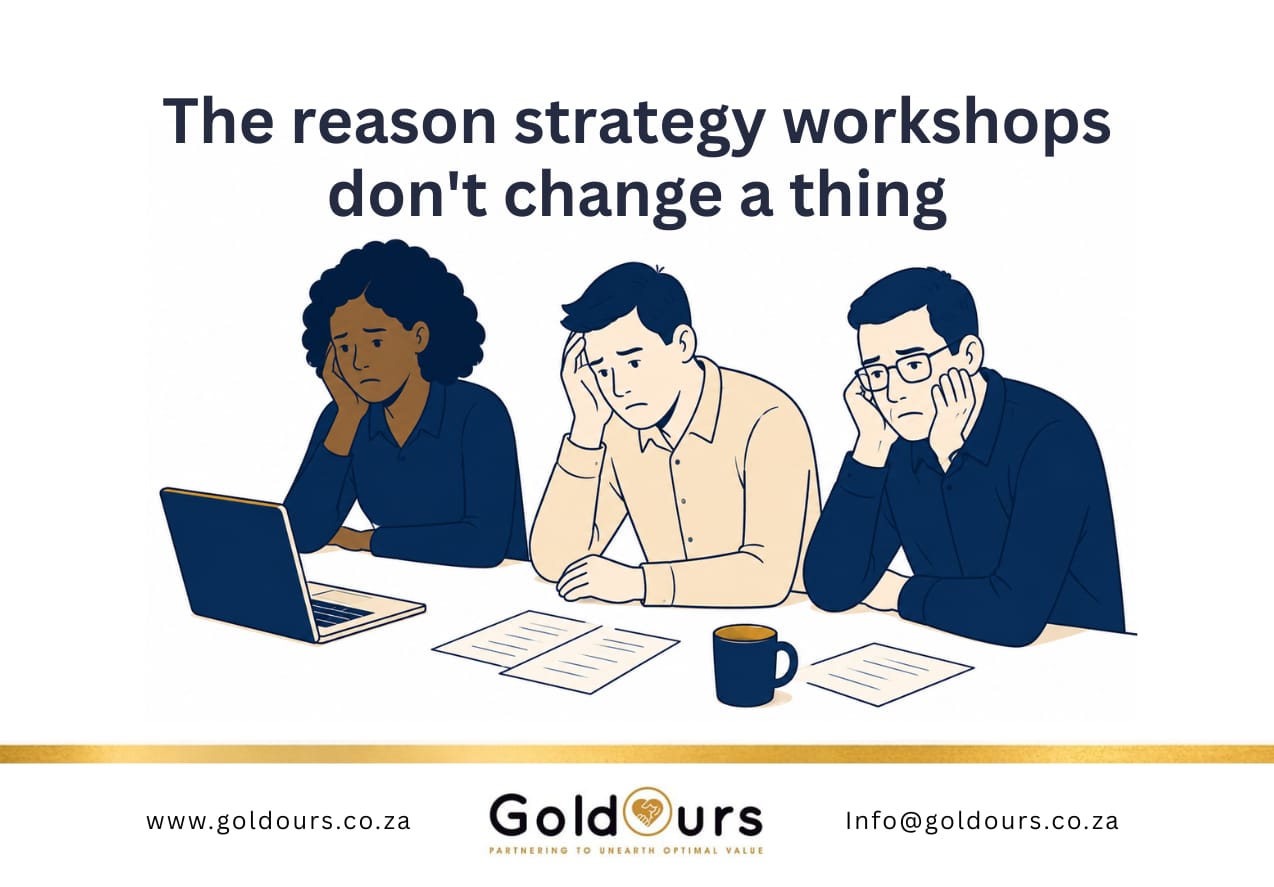
The real reason strategy workshops don't change anything
Most leadership teams leave strategy workshops feeling energised. The conversations were productive. The priorities were agreed. The vision feels clear.
For a brief moment, it seems as though the organisation is ready to move forward with renewed purpose.
Then six months later, very little has changed. The same challenges remain. The same obstacles persist. And the strategy that once generated excitement has quietly faded into the background. The problem is rarely the workshop itself. The problem is what happens afterwards.
The strategy workshop illusion
Strategy workshops have become a familiar feature of organisational life. Leadership teams step away from daily operations to reflect on the future. Important questions are asked. Difficult conversations take place. Decisions are made. The workshop concludes with a sense of achievement.
But many organisations confuse strategic agreement with strategic execution.
The workshop becomes the event. When in reality, it should only be the beginning. This is where many strategies start to lose momentum.
Warning signs
When strategy is treated as an event rather than a management system, the symptoms often appear quickly:
• Strategic priorities are rarely discussed after the workshop
• Business-as-usual activities regain control of leadership attention
• Employees struggle to connect their work to strategic objectives
• Progress reviews become inconsistent
• Accountability for execution becomes unclear.
From the outside, the strategy still exists. Inside the organisation, however, it is no longer influencing daily decisions.
Why growth makes this worse
As organisations grow, complexity increases. More teams become involved. More priorities compete for attention. More operational issues demand immediate action.
Without formal mechanisms to keep strategy visible, urgent matters inevitably replace important ones.
Leaders become consumed by operational demands. The strategy remains documented. Execution quietly stalls.
The real cost of workshop-driven strategy
Most organisations underestimate the consequences of weak execution discipline.
The hidden costs include:
Lost momentum
The energy generated during planning quickly disappears.
Leadership frustration
Executives repeatedly revisit discussions that should already have been resolved.
Resource waste
Initiatives begin without sustained support or follow-through.
Reduced credibility
Employees become sceptical when strategic priorities are announced but rarely reinforced.
Eventually, people stop treating strategy as something that drives decisions. They begin viewing it as another leadership exercise.
Strategy is not an event
One of the biggest misconceptions in leadership is that strategy happens during planning sessions. It doesn't. Strategy succeeds through consistent execution. That requires more than vision.
It requires governance. Governance creates the structures, reporting mechanisms, performance measures, and accountability systems that keep strategy alive long after the workshop ends.
Without those mechanisms, even the best strategies struggle to survive.
What leaders should do differently
1. Build execution into governance structures
Strategy should be a standing agenda item, not an annual discussion.
2. Align reporting with strategic priorities
What leaders review consistently becomes what the organisation focuses on.
3. Establish clear accountability
Every strategic objective should have visible ownership and measurable outcomes.
Final thought
When strategy fails to deliver results, organisations often question the quality of the plan. But the real problem may not be the plan.
It may be that the organisation treated strategy as a workshop instead of a management system.
Because successful organisations do not win through better planning sessions. They win through better execution.
GoldOurs helps leaders turn compliance, talent, and strategy into a single, powerful engine for tangible results.