
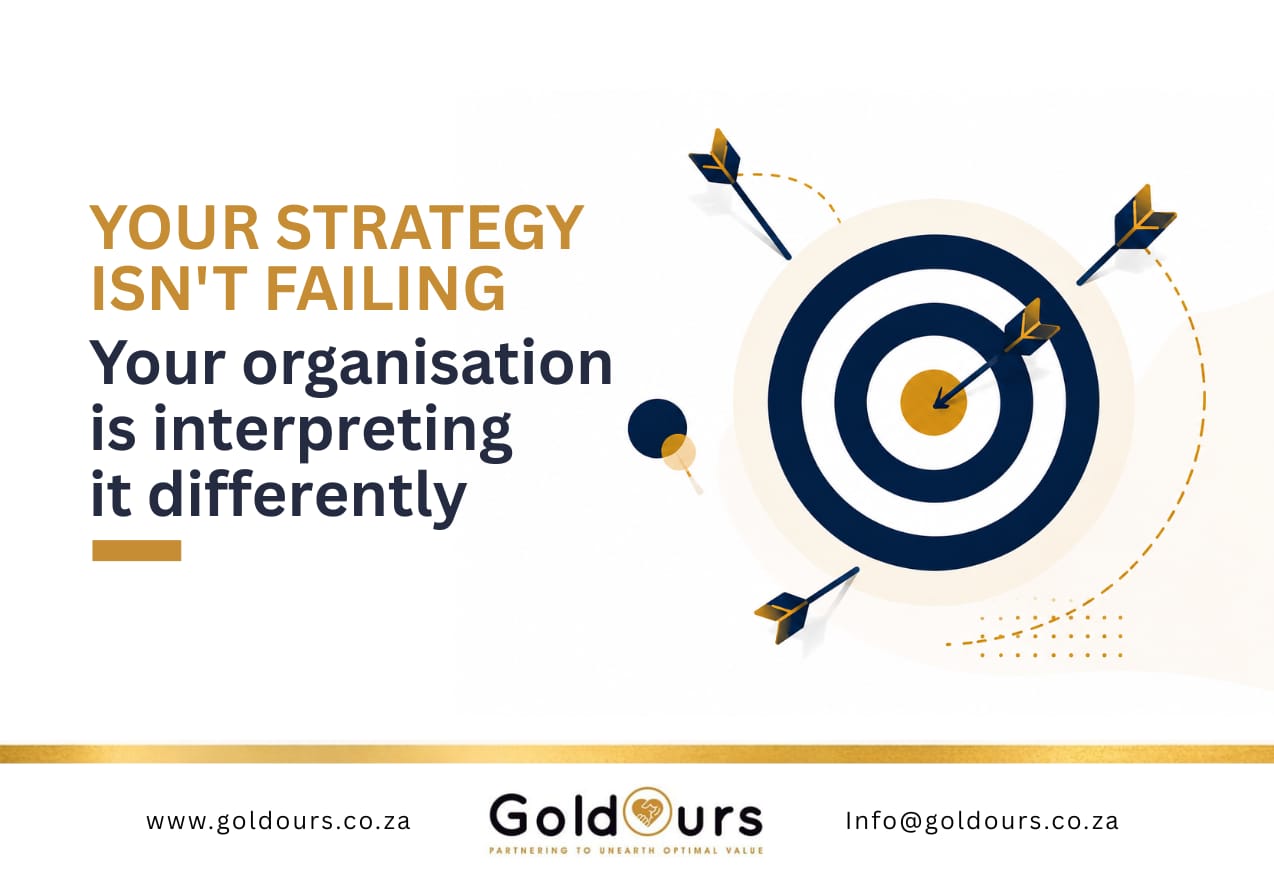
Your strategy isn’t failing — Your organisation is interpreting it differently
Most leadership teams believe they are aligned.
Until they ask five executives to explain the company’s strategy — and receive five different answers.
One talks about growth.
Another focuses on efficiency.
Finance prioritises cost control.
HR emphasises culture.
Sales push aggressive expansion.
Everyone is working hard, but not necessarily in the same direction.
That is how capable organisations lose momentum — not because the strategy was wrong, but because the business interpreted it differently.
Illusion of alignment
In many organisations, strategy is treated as a communication exercise instead of an operational discipline.
A strategy session is held.
Leadership agrees on priorities.
The annual objectives are circulated.
And everyone assumes alignment exists.
But agreement at executive level does not guarantee consistency across the organisation.
As departments interpret strategy through their own pressures and targets, competing priorities begin to emerge:
- Operations focuses on stability
- Sales pursues revenue growth
- Finance becomes increasingly risk-conscious
- HR drives transformation and talent priorities.
None of these goals are wrong individually. The problem is that without clear alignment, they begin competing with one another instead of reinforcing one another.
This is where strategic drift begins.
Warning signs
Misalignment rarely appears dramatically. It usually shows up quietly in everyday operations:
- Meetings end with different interpretations of the same decision
- Teams duplicate work across departments
- Employees struggle to explain key priorities
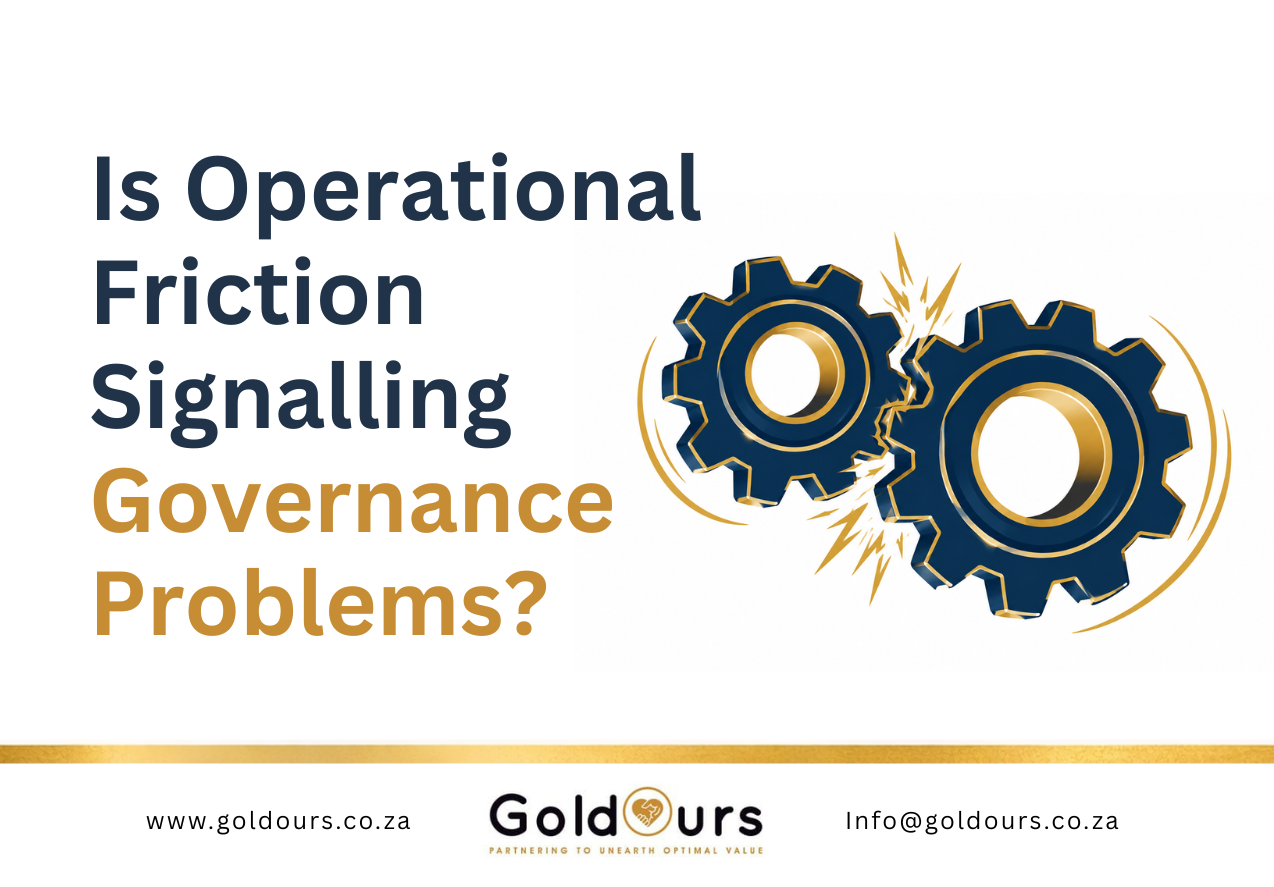
- Leaders spend excessive time resolving internal friction
- The organisation feels busy, but progress feels inconsistent.
From the outside, the business still appears functional. Inside, however, momentum is slowing.
Why growth makes this worse
As organisations grow, complexity increases.
What once worked through informal communication and founder-led decision-making becomes harder to sustain. More layers emerge, teams become more specialised, and decision-making spreads across the business.
Without deliberate alignment mechanisms, departments begin optimising for their own version of success.
The result is often:
- silo behaviour,
- conflicting priorities,
- slower decision-making,
- and leadership fatigue.
Many organisations mistake this for a strategy problem when it is actually an alignment problem.
Real cost of misalignment
Most companies underestimate how expensive misalignment becomes over time.
Not because it immediately appears on a balance sheet, but because it quietly weakens execution.
The hidden costs include:
Slower decisions
Teams revisit issues repeatedly because priorities are unclear.
Leadership exhaustion
Executives spend more time managing internal conflict than driving growth.
Reduced accountability
People struggle to take ownership when success itself is inconsistently defined.
Cultural fragmentation
Departments begin operating independently rather than collectively.
Eventually, even strong strategies lose credibility because employees no longer see consistency between what leaders say and what the organisation actually rewards.
Alignment is not about agreement
One of the biggest misconceptions in leadership is that alignment means consensus.
It doesn’t.
Alignment means:
- people understand the priorities,
- decisions consistently support those priorities,
- and leadership behaviour reinforces them.
In high-performing organisations, strategy is not reinforced once a year during planning sessions. It is reinforced continuously:
- through governance structures,
- operational reporting,
- performance measures,
- leadership communication,
- and accountability systems.
That consistency is what creates execution momentum.
What leaders should do differently
1. Simplify strategic priorities
Many organisations are trying to pursue too many priorities at once.
When everything is important, nothing gains traction.
Employees should clearly understand:
- what matters most,
- what success looks like,
- and what trade-offs are required.
Clarity drives alignment.
2. Build governance around execution
Strategy without governance becomes interpretation.
Leaders need mechanisms that continuously test whether teams, decisions, and operational behaviours remain aligned to strategic goals.
Good governance is not bureaucracy. It creates organisational coherence.
3. Align leadership behaviour
Employees pay more attention to leadership behaviour than leadership messaging.
If leaders promote collaboration but reward silo performance, teams notice. If executives communicate long-term thinking but make reactive decisions under pressure, credibility weakens.
Alignment starts with leadership consistency.
Because organisations eventually mirror what leaders repeatedly reinforce.
Final thought
When growth slows, organisations often revisit their strategy.
But sometimes the real issue is not the strategy.
It is that the organisation has quietly developed multiple competing interpretations of it.
And no strategy can succeed for long when the business is pulling in different directions.
GoldOurs helps leaders turn compliance, talent, and strategy into a single, powerful engine for tangible results.