
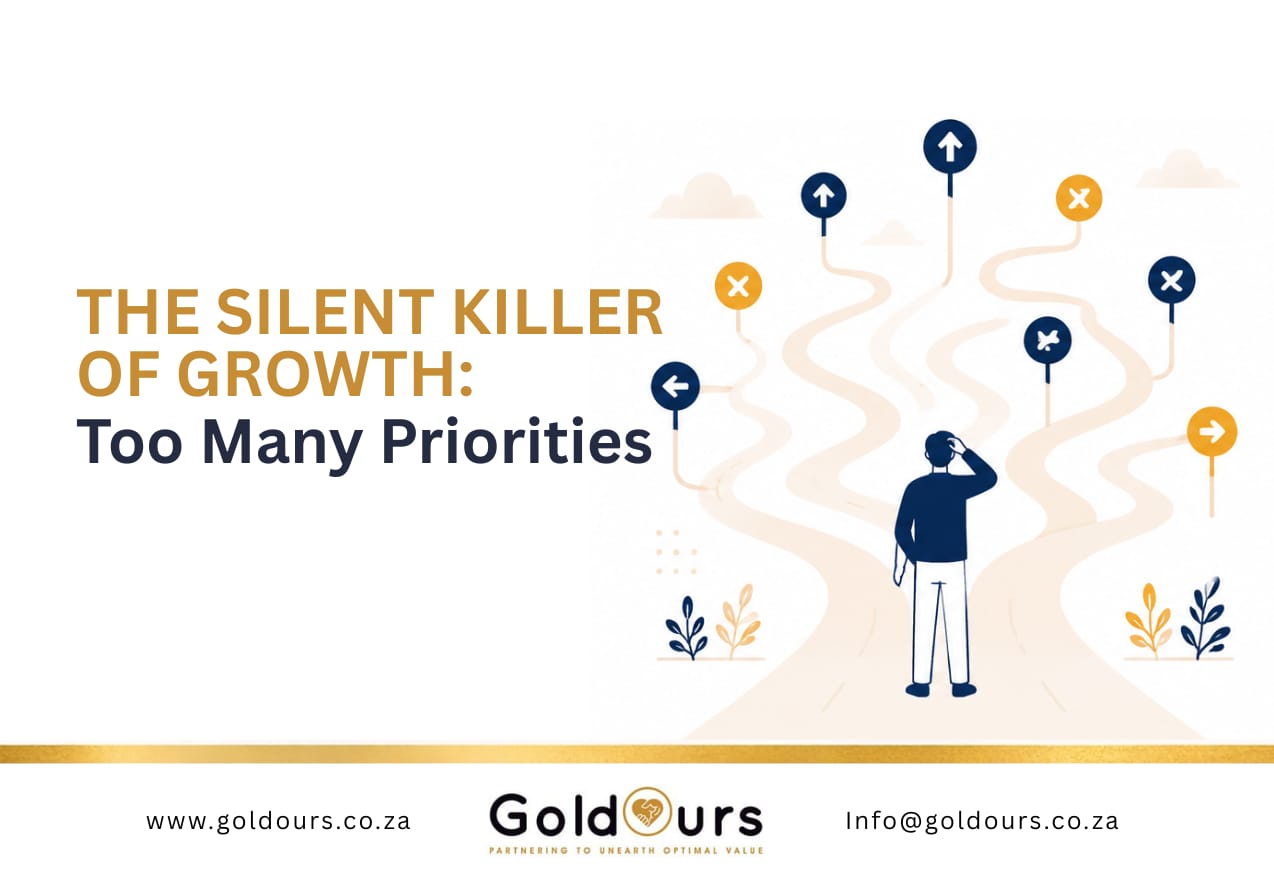
The Silent Killer of Growth: Too Many Priorities
Most companies don't fail from lack of ambition.
They fail from too much of it.
Ask most executive teams what their top priorities are, and you'll rarely hear fewer than ten.
Growth.
Transformation.
Customer experience.
Digital innovation.
Culture.
Talent.
Efficiency.
Governance.
Every initiative matters.
And that's precisely the problem.
Many leadership teams believe they are focused.
After all, priorities have been agreed.
Plans have been approved.
Targets have been assigned.
But when everything is labelled a priority, focus disappears.
The organisation becomes busy without becoming effective.
This is where execution paralysis begins.
Warning signs
Too many priorities often reveal themselves through:
- - Projects competing for the same resources
- - Constant reprioritisation
- - Delayed decision-making
- - Leadership frustration
- - Employees feeling overwhelmed
- - Strong activity but inconsistent results.
From the outside, the organisation appears productive.
Inside, momentum is slowing.
Why growth makes this worse
As organisations grow, complexity increases.
New opportunities emerge.
New stakeholders appear.
New risks demand attention.
The temptation is to add another initiative, another programme, another objective.
Rarely is anything removed.
Over time, organisations accumulate priorities faster than they build the capacity to execute them.
The result is predictable.
Focus becomes fragmented.
The real cost of too many priorities
Most organisations do not feel the impact immediately.
Instead, it appears gradually through:
Slower execution
Resources are spread too thinly.
Decision fatigue
Competing objectives create uncertainty.
Accountability gaps
Ownership becomes diluted.
Strategic drift
Teams begin pursuing different versions of success.
Eventually, growth slows despite significant effort.
Prioritisation is not a planning exercise
One of the biggest misconceptions in leadership is that prioritisation happens during strategy sessions.
It doesn't.
True prioritisation is an ongoing governance discipline.
It requires leaders to decide:
- - What will receive resources
- - What will receive attention
- - What will be delayed
- - What will stop.
Good governance creates these choices.
Without it, organisations simply accumulate more priorities every year.
What leaders should do differently
1. Reduce strategic priorities
Focus creates momentum.
Complexity creates drag.
2. Align performance measures
People focus on what gets measured.
Ensure performance indicators reinforce strategic priorities.
3. Build governance around execution
Governance should continuously test whether effort, resources, and decisions remain aligned.
Final thought
When growth stalls, organisations often look for a new strategy.
But the real problem may not be the strategy.
It may be that the organisation is trying to execute too many priorities at once.
Because growth is rarely constrained by a lack of ambition.
More often, it is constrained by a lack of focus.
GoldOurs helps leaders turn compliance, talent, and strategy into a single, powerful engine for tangible results