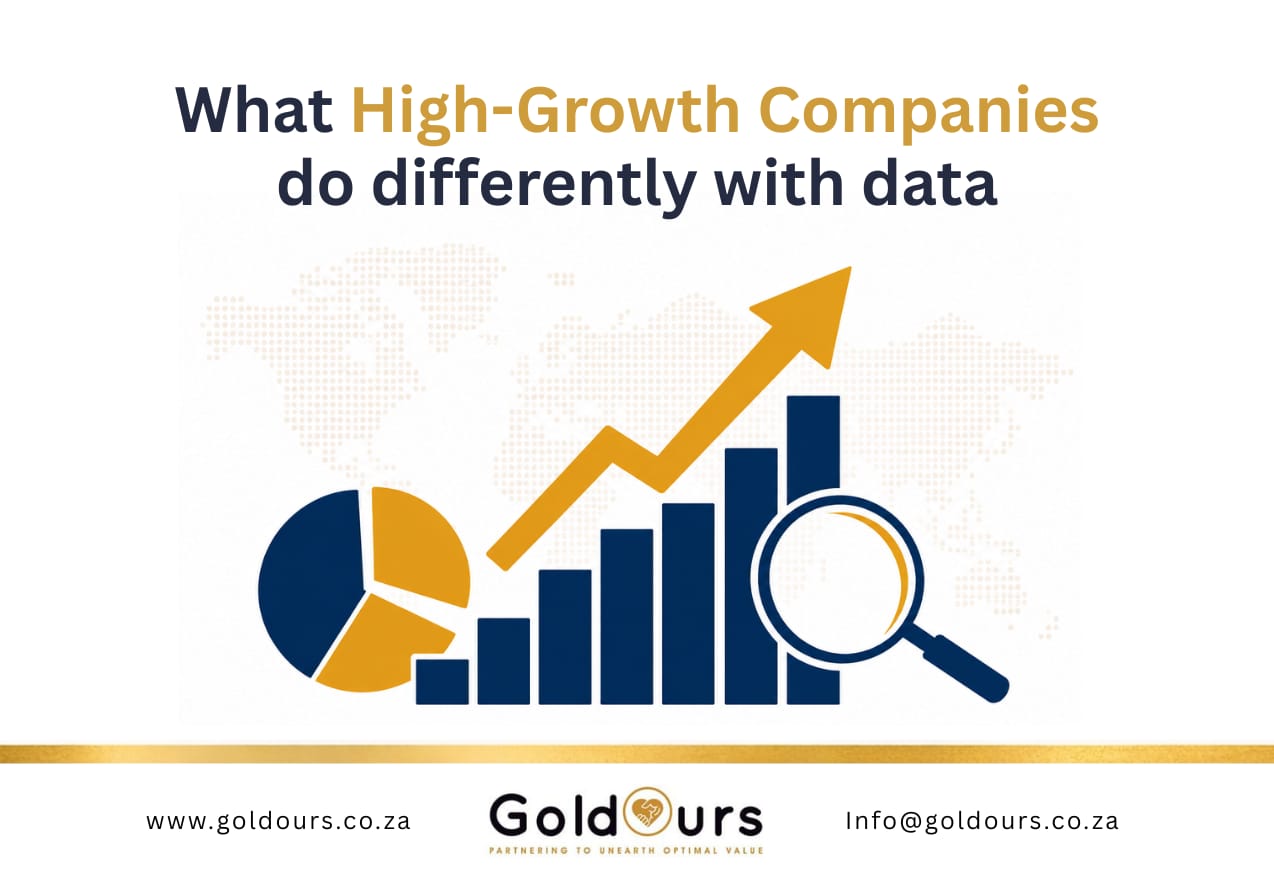
What high-growth companies do differently with data
How profitable is our most important customer segment? Which business unit is performing best? What is our biggest operational risk?
Finance has one answer. Operations has another. Sales sees something entirely different.
Everyone has data. Yet nobody has a shared understanding of what is actually happening inside the business. This is where decision inconsistency begins.
And it is one of the most overlooked barriers to sustainable growth.
The illusion of being data-driven
In today’s business environment, organisations have access to more information than ever before.
Dashboards are everywhere. Reports are generated daily. Key performance indicators fill leadership meetings.
On the surface, it appears that organisations have all the information they need to make good decisions.
But access to information is not the same as insight. Many organisations are drowning in data while starving for clarity. Different teams measure success differently. Reports focus on activity rather than outcomes. Critical information sits in separate systems.
And when the data doesn’t provide clear answers, leaders often rely on instinct and assumptions. This is where strategic risk begins to emerge.
Warning signs
Decision inconsistency rarely appears dramatically.
It usually reveals itself through everyday frustrations:
· - Leadership meetings focus on debating the numbers instead of making decisions.
· - Different departments produce different versions of the same report.
· - Strategic priorities shift because the underlying information keeps changing.
· - Leaders revisit decisions that were supposedly settled.
· - Teams spend more time collecting data than acting on it.
From the outside, the organisation appears informed.
Inside, however, confidence in decision-making is quietly eroding.
Why does growth make this worse
As organisations grow, complexity increases. There are more customers. More products. More processes. More systems. More decisions.
The cost of making decisions based on assumptions becomes significantly higher. A small reporting inconsistency can delay major investment decisions. A missed performance indicator can allow an operational issue to grow unnoticed. A lack of visibility can result in resources being allocated to the wrong priorities. What once seemed manageable becomes a barrier to growth.
Because growth requires clarity. And clarity depends on trusted information.
The real cost of operating on assumptions
Most organisations underestimate how expensive poor information becomes over time. The hidden costs include:
Slower decisions
Leaders hesitate because they lack confidence in the information before them.
Misallocated resources
Money and effort are directed towards assumptions rather than evidence.
Reduced accountability
Ownership becomes difficult when success is measured inconsistently.
Reactive management
Problems are identified only after they have already affected performance.
Eventually, the organisation becomes skilled at explaining results rather than improving them.
Data is not the same as insight
One of the biggest misconceptions in leadership is that more data automatically leads to better decisions. It doesn’t.
High-growth companies are not necessarily collecting more information than everyone else.
They are using information differently. They create a single version of the truth. They establish clear performance measures. They regularly test assumptions against evidence.
Most importantly, they build systems that turn information into action. Because data only creates value when it improves decisions.
What high-growth companies do differently
1. They create a common view of performance
Everyone works from the same measures, definitions, and objectives.
The conversation shifts from debating the numbers to deciding what to do next.
2. They build governance around information
Good governance ensures that data is accurate, trusted, and relevant.
Performance information becomes an organisational asset rather than a reporting exercise.
3. They review performance systematically
High-growth organisations do not wait for problems to emerge.
They have structured review processes that identify risks, track progress, and support informed decision-making.
Performance conversations become part of the operating rhythm of the business.
4. They challenge assumptions
The most successful leaders ask:
· - What does the data actually tell us?
· - What are we assuming?
· - What evidence supports our decisions?
This discipline leads to better decisions and outcomes.
Insight creates confidence
People perform differently when they trust the information around them. Leaders make decisions faster. Teams focus on the right priorities. Resources are allocated more effectively. Accountability becomes clearer.
And the organisation becomes far more capable of responding to change.
This is why high-growth companies invest as much in performance insight and governance as they do in strategy itself.
Because sustainable growth depends on understanding reality—not assumptions.
Final thought
When organisations struggle to execute, they often look for a new strategy, a new structure, or a new system.
But sometimes the real issue is much simpler.
The business is making decisions without a shared understanding of what is actually happening. Because growth is not driven by having more data.
It is driven by having the right information, asking the right questions, and creating the discipline to act on what the evidence reveals.
GoldOurs helps leaders turn compliance, talent, and strategy into a single, powerful engine for tangible results